
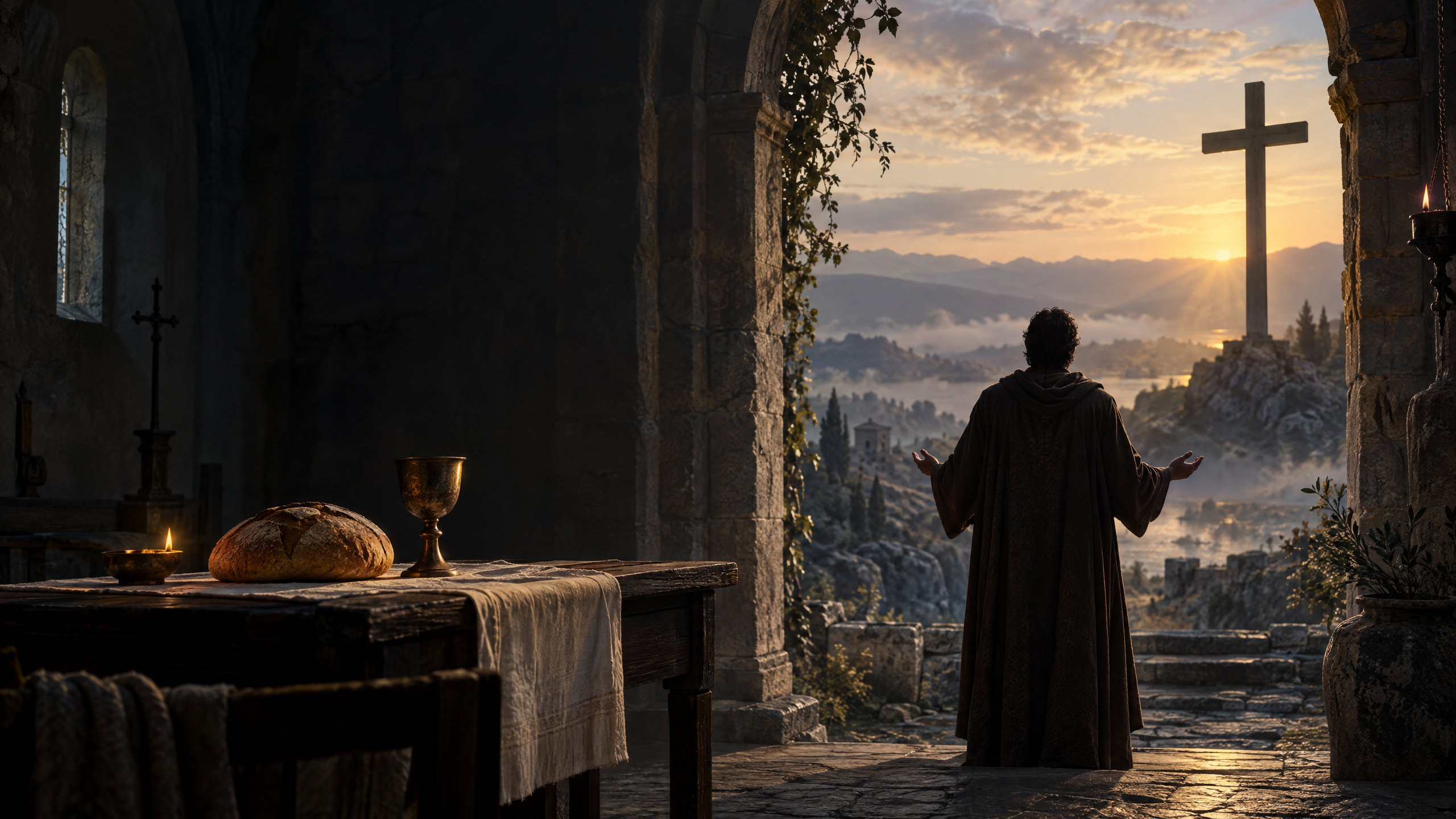

On the Cross, the Eucharist, and the offering of one’s life
Sacrifice is one of the oldest and most enduring features of religious life. Across civilizations, human beings have offered gifts to the divine: food, incense, animals, possessions, and even their own lives. Such offerings express a recognition that the sacred is not simply another object within the world, but something before which the human person must stand in a different relation.
Christianity inherits this ancient understanding of sacrifice, but transforms it through a singular event: the Crucifixion of Christ.
The Christian understanding of sacrifice cannot be reduced to the surrender of something valuable, nor to the voluntary acceptance of suffering. Its deepest meaning is found in the relationship between offering, obedience, and love.
The question is not merely what is sacrificed.
It is what the sacrifice expresses, and to whom it is offered.
The Ancient Meaning of Sacrifice
The word sacrifice derives from the Latin sacrificium, literally an act of making sacred.
In its traditional religious sense, sacrifice is an offering through which something is consecrated to the divine. It establishes or expresses a relationship between the human and the sacred.
The Old Testament contains numerous forms of sacrifice. Offerings of thanksgiving, purification, atonement, and communion all appear within the religious life of Israel.
These sacrifices were not interchangeable. They possessed distinct meanings and purposes within the covenantal relationship between God and His people.
Yet they shared a common orientation: the recognition that the human person does not exist in absolute independence.
Life is received. The world is received. Even the capacity to offer something is itself a gift.
Sacrifice therefore begins with an acknowledgment of dependence.
It is an act through which the human person recognizes that the highest good cannot be reduced to personal possession.
The Sacrifice of Christ
Christianity understands the Cross as the fulfillment of the sacrificial tradition of Israel.
Christ does not merely offer something external to Himself. He offers Himself.
His sacrifice is not an attempt to purchase divine favor, nor a demonstration that suffering is inherently desirable. It is the supreme expression of obedience and self-giving love.
The Gospel of John presents Christ’s death in the context of love:
“Greater love hath no man than this, that a man lay down his life for his friends.”
— John 15:13
The Cross reveals a paradox at the heart of Christian theology.
The act of supreme surrender becomes the act of supreme victory.
Death becomes the passage to resurrection. Obedience becomes the means of reconciliation. What appears to be the defeat of the righteous becomes the foundation of redemption.
The Christian does not understand this sacrifice as one among many equivalent offerings. Christ’s sacrifice is unique and definitive.
The Epistle to the Hebrews emphasizes that Christ offered Himself once for all.
Human beings do not complete His sacrifice through their own suffering. They do not purchase salvation through the accumulation of personal sacrifices.
Rather, Christian life unfolds in response to the sacrifice already accomplished.
The Eucharist: The Sacrifice Made Present
The Eucharist occupies a central place in Christian sacrificial theology.
For Catholics and Orthodox Christians, the Eucharist is not merely a symbolic recollection of an event in the distant past. It is participation in the mystery of Christ’s sacrifice, made present sacramentally.
Catholic theology particularly emphasizes the Eucharist as the sacramental re-presentation of the one sacrifice of Christ. It is not a repetition of the Crucifixion, but participation in the same offering.
Other Christian traditions understand the relationship between the Eucharist, the Cross, and sacrificial language differently. Yet across much of Christianity, the Lord’s Supper remains inseparable from the remembrance of Christ’s self-giving.
The significance of this is profound.
Christian worship is not simply the expression of religious sentiment. It is a participation in a reality that precedes the worshipper.
The individual does not approach God as an autonomous being bringing something of his own invention. He approaches through Christ.
The offering is not ultimately the possession of the individual.
It is the response of the individual to the gift of God.
The Offering of One’s Life
What, then, does sacrifice mean for the Christian outside the liturgy?
Saint Paul writes:
“I beseech you therefore, brethren, by the mercies of God, that ye present your bodies a living sacrifice, holy, acceptable unto God, which is your reasonable service.”
— Romans 12:1
The phrase living sacrifice is striking.
Unlike the sacrifice of the altar, the Christian’s offering unfolds through the ordinary circumstances of life.
The body is offered through action. The will is offered through obedience. Time is offered through service. Possessions are offered through generosity.
The Christian life becomes an act of consecration.
This does not mean that every inconvenience is a sacrifice in the religious sense, nor that suffering must be sought in order to make one’s life meaningful.
It means that the individual is no longer understood as the absolute proprietor of his existence.
His life has a purpose beyond the satisfaction of his own desires.
The offering of one’s life is therefore expressed through fidelity: to God, to one’s legitimate duties, to the truth, and to the neighbor.
The ordinary can become sacred through its proper orientation.
A labor undertaken honestly. A promise kept when it becomes difficult. A wrong forgiven. A duty fulfilled without recognition.
These are not substitutes for the sacrifice of Christ.
They are ways in which the Christian life is conformed to its pattern.
Sacrifice and the Problem of Self-Will
Modern culture frequently identifies freedom with the absence of obligation.
The individual is encouraged to regard his desires as the ultimate measure of his life. Anything that limits those desires is treated as an obstacle to fulfillment.
The Christian understanding of sacrifice challenges this assumption.
A person who cannot relinquish anything is not necessarily free. He may be governed by the very things he believes he possesses.
The desire for comfort can become a master. The pursuit of recognition can become a form of servitude. Even the demand for personal autonomy can become an attachment that prevents the individual from entering into meaningful relationships.
Sacrifice confronts this condition.
It is the deliberate recognition that something greater than the self deserves one’s allegiance.
Yet Christian sacrifice must be distinguished from the glorification of suffering or the passive acceptance of injustice.
The Christian is not called to surrender truth, dignity, or legitimate responsibility simply because another person demands it.
Sacrifice is not the abandonment of moral judgment.
It is the offering of oneself in accordance with the good.
What Is Offered, and to Whom?
The Christian understanding of sacrifice ultimately returns to the question of love.
What is offered?
The person himself: not merely his possessions, not merely his time, but his will, his actions, and the orientation of his life.
To whom is it offered?
To God, through Christ.
This offering is not an attempt to establish a relationship that does not yet exist. It is a response to the relationship established through divine grace.
The Christian does not sacrifice in order to make God benevolent.
He sacrifices because God has already given Himself.
The Cross therefore stands as the measure of Christian sacrifice. It reveals that the highest form of offering is not the destruction of what is good, but the willing surrender of oneself in love.
Penance corrects the disorder of the soul.
Asceticism trains the will.
Mortification overcomes disordered desire.
Sacrifice gives the whole person a direction.
And that direction is not toward suffering, but toward God.
The Christian does not offer his life because life is worthless.
He offers it because life possesses a meaning greater than the self.
The ultimate purpose of Christian sacrifice is not to lose something for its own sake, but to give oneself to the highest good.