

During the Agony in the Garden, Our Lord Jesus endured three sets of sorrows, so to speak: First he was shown all the sins of the world, from its beginning to its end, then it was made known to Him what exactly He would have to endure during His 15-hour torture, and lastly He was shown all the ingratitude Christians would offer Him in return for His immense sacrificial labor.
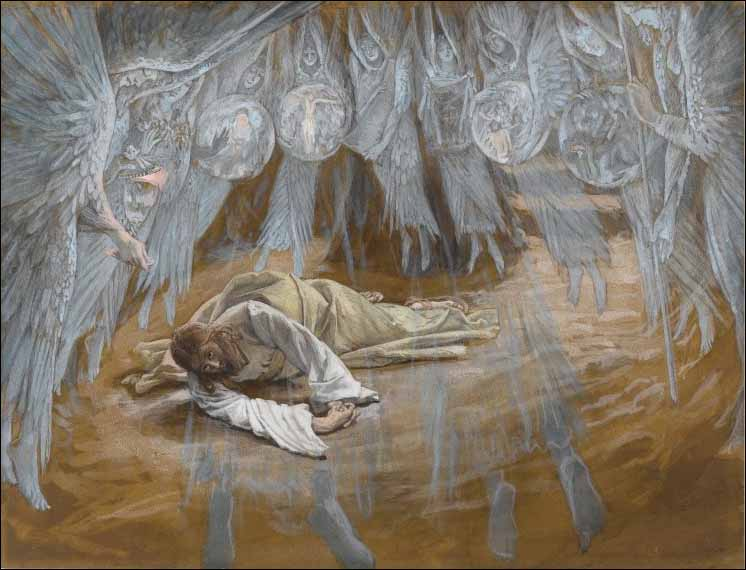
Blessed Anne Catherine Emmerich’s Visions shed light on just how harrowing of an experience Our Lord had. In these last two weeks leading up to Holy Week, I invite you, esteemed reader, to contemplate especially on this aspect of our Lord’s Passion, and your contribution to it. Watch and pray.
The quoted passages below all fall within the time frame of Lk 22:39-44:
“And going out, he went, according to his custom, to the Mount of Olives. And his disciples also followed him. And when he was come to the place, he said to them: Pray, lest ye enter into temptation. And he was withdrawn away from them a stone’s cast. And kneeling down, he prayed. Saying: Father, if thou wilt, remove this chalice from me: but yet not my will, but thine be done. And there appeared to him an angel from heaven, strengthening him. And being in an agony, he prayed the longer. And his sweat became as drops of blood, trickling down upon the ground.”
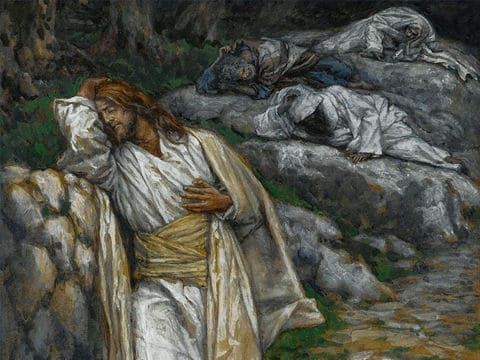
Excerpts from Anne Catherine Emmerich: The Dolorous Passion of Our Lord Jesus Christ
(London: Burns and Lambert, 1862, p.58 – 65; emphasis added)
“He fell on his face, overwhelmed with unspeakable sorrow, and all the sins of the world displayed themselves before him, under countless forms and in all their real deformity. He took them all upon himself, and in his prayer offered his own adorable Person to the justice of his Heavenly Father, in payment for so awful a debt. (…) Among the sins of the world which Jesus took upon himself, I saw also my own; and a stream, in which I distinctly beheld each of my faults, appeared to flow towards me from out of the temptations with which he was encircled. During this time my eyes were fixed upon my Heavenly Spouse; with him I wept and prayed, and with him I turned towards. the consoling angels. Ah, truly did our dear Lord writhe like a worm beneath the weight of his anguish and sufferings! (…)
The remainder of the grotto was filled with frightful visions of our crimes; Jesus took them all upon himself, but that adorable Heart, which was so filled with the most perfect love for God and man, was flooded with anguish, and overwhelmed beneath the weight of so many abominable crimes. When this huge mass of iniquities, like the waves of a fathomless ocean, had passed over his soul, Satan brought forward innumerable temptations, as he had formerly done in the desert, even daring to adduce various accusations against him. ‘And takest thou all these things upon thyself,’ he exclaimed, ‘thou who art not unspotted thyself?’ Then he laid to the charge of our Lord, with infernal impudence, a host of imaginary crimes. (…)
In one word Satan, in the hopes of causing Jesus to waver, suggested to him every thought by which he would have tempted at the hour of death an ordinary mortal who might have performed all these actions without a superhuman intention; for it was hidden from him that Jesus was the Son of God, and he tempted him only as the most just of men. Our Divine Saviour permitted his humanity thus to preponderate over his divinity, for he was pleased to endure even those temptations with which holy souls are assailed at the hour of death concerning the merit of their good works. That he might drink the chalice of suffering even to the dregs, he permitted the evil spirit to tempt his sacred humanity, as he would have tempted a man who should wish to attribute to his good works some special value in themselves, over and above what they might have by their union with the merits of our Saviour.
(…)
When Jesus, unrelieved of all the weight of his sufferings, returned to the grotto, he fell prostrate, with his face on the ground and his arms extended, and prayed to his Eternal Father; but his soul had to sustain a second interior combat, which lasted three-quarters of an hour. Angels came and showed him, in a series of visions, all the sufferings that he was to endure in order to expiate sin (…)
He beheld how all sins originated in that of Adam, the signification and essence of concupiscence, its terrible effects on the powers of the soul, and likewise the signification and essence of all the sufferings entailed by concupiscence. They showed him the satisfaction which he would have to offer to Divine Justice, and how it would consist of a degree of suffering in his soul and body which would comprehend all the sufferings due to the concupiscence of all mankind, since the debt of the whole human race had to be paid by that humanity which alone was sinless—the humanity of the Son of God. (…) No tongue can describe what anguish and what horror overwhelmed the soul of Jesus at the sight of so terrible an expiation—his sufferings were so great, indeed, that a bloody sweat issued forth from all the pores of his sacred body.
(…)
The soul of Jesus beheld all the future sufferings of his Apostles, disciples, and friends; after which he saw the primitive Church, numbering but few souls in her fold at first, and then in proportion as her numbers increased, disturbed by heresies and schisms breaking out among her children, who repeated the sin of Adam by pride and disobedience. He saw the tepidity, malice, and corruption of an infinite number of Christians, the lies and deceptions of proud teachers, all the sacrileges of wicked priests, the fatal consequences of each sin, and the abomination of desolation in the kingdom of God, in the sanctuary of those ungrateful human beings whom he was about to redeem with his blood at the cost of unspeakable sufferings. (…) Our Divine Saviour beheld with bitterest anguish the ingratitude and corruption of the Christians of the first and of all succeeding ages, even to the end of the world, and during the whole of this time the voice of the tempter was incessantly repeating: ‘Canst thou resolve to suffer for such ungrateful reprobates?’ while the various apparitions succeeded each other with intense rapidity, and so violently weighed down and crushed the soul of Jesus, that his sacred humanity was overwhelmed with unspeakable anguish. (…)
It was made known to me that these apparitions were all those persons who in divers ways insult and outrage Jesus, really and truly present in the Holy Sacrament. I recognised among them all those who in any way profane the Blessed Eucharist. I beheld with horror all the outrages thus offered to our Lord, whether by neglect, irreverence, and omission of what was due to him; by open contempt, abuse, and the most awful sacrileges; by the worship of worldly idols; by spiritual darkness and false knowledge; or, finally, by error, incredulity, fanaticism, hatred, and open persecution.
Among these men I saw many who were blind, paralysed, deaf, and dumb, and even children;—blind men who would not see the truth; paralytic men who would not advance, according to its directions, on the road leading to eternal life; deaf men who refused to listen to its warnings and threats; dumb men who would never use their voices in its defence; and, finally, children who were led astray by following parents and teachers filled with the love of the world and forgetfulness of God, who were fed on earthly luxuries, drunk with false wisdom, and loathing all that pertained to religion. Among the latter, the sight of whom grieved me especially, because Jesus so loved children, I saw many irreverent, ill-behaved acolytes, who did not honour our Lord in the holy ceremonies in which they took a part. (…)
Among these bands I saw a great number of theologians, who had been drawn into heresy by their sins, attacking Jesus in the Holy Sacrament of his Church and snatching out of his Heart, by their seductive words and promises, a number of souls for whom he had shed his blood. Ah! it was indeed an awful sight, for I saw the Church as the body of Christ; and all these bands of men, who were separating themselves from the Church, mangled and tore off whole pieces of his living flesh. Alas! he looked at them in the most touching manner, and lamented that they should thus cause their own eternal loss. He had given his own divine Self to us for our Food in the Holy Sacrament, in order to unite in one body—that of the Church, his Spouse—men who were to an infinite extent divided and separated from each other; and now he beheld himself torn and rent in twain in that very body; for his principal work of love, the Holy Communion, in which men should have been made wholly one, was become, by the malice of false teachers, the subject of separation. (…) Finally, I saw all who were separated from the Church plunged into the depths of infidelity, superstition, heresy, and false worldly philosophy; and they gave vent to their fierce rage by joining together in large bodies to attack the Church, being urged on by the serpent which was disporting itself in the midst of them.
Alas! it was as though Jesus himself had been torn in a thousand pieces!“
Quotes all taken from this pdf:
Anne Catherine Emmerich: The Dolorous Passion of Our Lord Jesus Christ